Transdisciplinary (TD) work is more than teamwork. It’s about bringing together people from science, medicine, community, advocacy, policy, and lived experience to not just share ideas, but to generate new ones. It’s a way of working that honors every kind of knowledge, from lab research to lived experience. (Want a deeper dive into the TD approach? Check out our earlier blog.)
That diversity of experience is TD work’s greatest strength—but also one of its biggest challenges. With so many perspectives, you’re bound to encounter different ways of thinking and doing. Some team members are reflective processors who need time to consider options. Others want to act quickly and keep up momentum. Still others are systems thinkers who look for long-term ripple effects before committing to next steps.
These differences can create tension. But when facilitators make space for all of them to coalesce, the result is better insights—and better solutions.
A Tool That Meets People Where They Are
In our eight years supporting TD teams working on health equity and systems change, we’ve built a deep toolbox of methods to help groups learn, reflect, plan, and act—while honoring the variety of problem-solving styles they bring to the table.
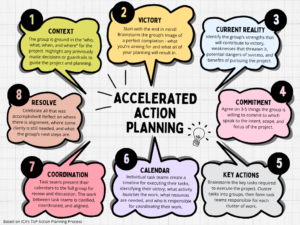
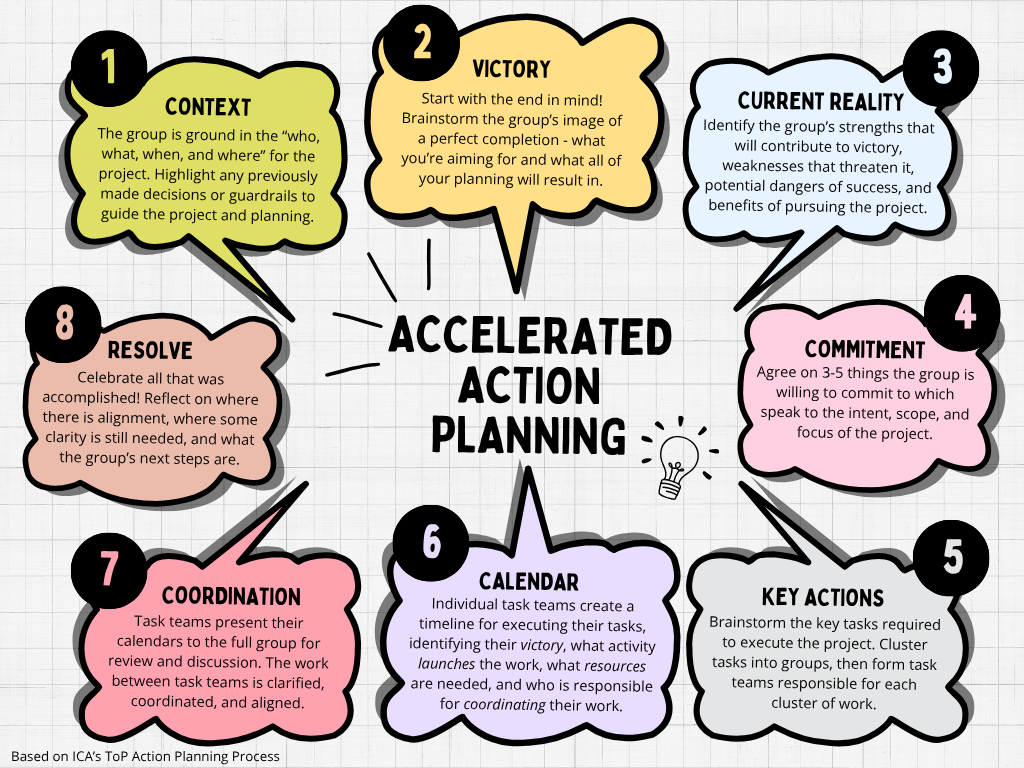
One tool we return to again and again is the Technology of Participation (ToP) Action Planning Process, developed by the Institute of Cultural Affairs. It helps teams move from vision to action, especially when the task ahead feels overwhelming or unclear.
- ToP Action Planning supports teams in:
- Reconnecting with their shared purpose
- Breaking large goals into concrete, time-bound steps
- Identifying risks and barriers before they become roadblocks
- Ensuring all voices are engaged in shaping the path forward
The process is structured enough to keep things moving, but flexible enough to allow for reflection and divergent thinking. It’s especially useful for TD teams because it supports multiple ways to engage—out loud, in writing, asynchronously, or through visual platforms like Miro.
A Case in Point: Action Planning in Walworth County
We recently used ToP Action Planning with a team addressing lung cancer disparities among Latine/Hispanic residents in Walworth County, Wisconsin. After a multi-year design phase, the team faced delays due to staffing transitions and political shifts. They needed to regroup and re-focus for implementation.
To prepare, we introduced the virtual collaboration platform, Miro, ahead of time and provided a written how-to guide, along with optional one-on-one tech support. This helped participants of all technology comfort levels get ready to engage. Before the session, we asked team members to brainstorm key tasks for the next six months. This gave reflective thinkers time to prepare and helped doers feel momentum from the start.
In our virtual sessions, we blended small- and large-group conversation to group the tasks into categories of work. People could contribute however felt natural—speaking, typing in the chat, or moving items on the shared board—while a note-taker captured ideas in real time. Between meetings, the board remained open for additional input, allowing ideas to keep evolving and those who like more processing time to do their thing.
By the end of the process, the team had a clear, actionable plan—and something more. They felt reconnected to each other and re-energized about the work ahead. The process made space for everyone to contribute, in their own way and at their own pace.
Getting Started with ToP Action Planning
If you’re looking for a way to help your team turn ideas into action while honoring different thinking styles, ToP Action Planning is a strong place to start. Here are a few tips:
- Start with pre-work. Ask team members to brainstorm tasks or goals ahead of time. This levels the playing field for reflective thinkers and gives doers an early win.
- Use a shared digital board. Tools like Miro allow for visual collaboration and flexibility in how people contribute. Take time to prep your team so it is an engagement supporter, not a barrier.
- Create a “no wrong door” approach. Make space for people to participate in multiple ways—speaking, writing, reacting, or just reflecting. And allow people to come back to the work as ideas evolve.
- Slow down when needed. If big questions arise, pause. Address the concerns, then return to planning. It’s better to go slow together than fast alone.
By using adaptable, inclusive tools, TD teams can align around purpose, build trust and shared ownership, and stay connected through complexity. Whether you’re a reflective processor, an action-oriented doer, or a systems thinker, there’s a place—and a process—for you in TD work.
Curious what tools might support your team’s next step? Let’s talk.
Laura and Kristen are both certified in ToP facilitation methods through the Institute of Cultural Affairs in the USA.